Showing posts with label Jim Gamble. Show all posts

Sunday, July 21, 2019

Richard D. Hall: Gambling with Paedophiles (and an appeal)


Another excellent 'Madeleine' film from the Richard D. Hall collections, all of which can be found here: http://www.madeleinefilms.net/

At the end of this 'Gambling with Paedophiles' film, Richard puts out an appeal for someone who has an excellent command of both the English and Portuguese languages who can translate accurately English into Portuguese. The MMRG are looking to put Portuguese subtitles into Richard's films. Fee to be negotiated. We already have someone who has volunteered to do the editing work for us, we just need a translator.

If you can be of assistance to us, then please contact Richard at richard@richplanet.net, or Tony Bennett at ajsbennett@btinternet.com

Many thanks

Jill Havern
Forum owner The Complete Mystery of Madeleine McCann™

Wednesday, July 17, 2019

Richard D. Hall: Gambling with paedophiles


Richard Hall  Published on Jul 16, 2019


People often ask if there will be more Madeleine material from Richplanet, as if there hadn't been enough already! The big question which everyone asks once they have got past the official narrative "abduction" nonsense, is why did the UK government and all it's various tentacles help cover the Madeleine McCann case up? Today I provide a hypothesis on the reason for a cover up. I do not know if it is correct, and I welcome new evidence which supports or refutes this theory. 

The words, "I'm not here to enjoy myself" can be applied in a more general sense when discussing the reason you were put on this planet. A lesson to hedonists.
-------------------

More topics of discussion on CMOMM:

Thursday, June 27, 2019

JOINED AT THE HIP - Starring the McCanns and Jim Gamble

image courtesy of the McCann Gallery

MMRG updated this article on 14 May 2019. It was originally written by Tony Bennett on 8 April 2014.

The purpose of Tony's article was to inform CMOMM readers about the astonishingly close relationship between Jim Gamble and the McCanns, right from the moment Madeleine was reported missing, and to explain how two other characters, psychologist Dr Joe Sullivan and criminologist and 'child abuse expert', Mark Williams-Thomas, have also been very closely connected with both the McCanns and Jim Gamble.

UPDATE: Since Tony wrote his article, information emerged during 2017 that the 'Wayback Machine', which interrogates websites, forums and blogs etc. and which can give a complete history of created pages, articles and posts etc., had found what has been called a 'dummy entry' (i.e. a blank page) for 'Madeleine McCann' on the CEOP website, dated 30 April 2007. Jim Gamble was the Head of CEOP at the time.

This intended to confirm the views of many that something serious had happened to Madeleine McCann the day before (Sunday 29 April), and that this page had been set up - ready and waiting, so to speak - for the day later in the week when the McCanns would formally announce that Madeleine had been 'abducted'. 

MMRG would like to add the following. When challenged by Madeleine McCann about the entry for 30 April, Wayback Machine originally confirmed that the entry was genuine, adding that Wayback Macine had such an excellent reputation that its evidence was often used in the U.S. courts. However, days later, after considerable publicity over this find on the internet, Wayback Machine changed their story, claiming it was only a 'glitch'. 

One of the many who doubted this was merely a glitch was Richard Hall, an electronic engineer with vast I.T. experience on the internet, computers and digital technology. He is also the maker of five extremely informative documentaries on the Madeleine McCann case, which have been viewed by millions.   


PART ONE

JOINED AT THE HIP

Starring the McCanns and Jim Gamble

Supporting cast: Psychologist Dr Joe Sullivan and ‘child abuse expert’ Mark Williams-Thomas

The remarkable tale of three middle-aged men who hover around the McCann case, seemingly for ever.

Three middle-aged men who, like the Portuguese Police, Scotland Yard and a whole host of private detectives employed by the McCanns – and like the rest of us – do not know yet what really happened to Madeleine McCann. But three middle-aged men all deeply interested in the subject of child sexual abuse – and who keep linking their interest to the McCanns.

This little article consists of a few cobbled-together notes of how often they’ve popped up here and there to make comments about the disappearance of Madeleine McCann. It may not be the complete picture. Detective Chief Superintendent Graham Hill also gets a mention.


Profile: Jim Gamble (BBC)

JOINED AT THE HIP - Starring the McCanns and Jim Gamble _49373922_010341846-1

Jim Gamble resigned because he wanted greater independence for CEOP

The resignation of Jim Gamble from his position as Chief Executive of the Child Exploitation and Online Protection Centre (Ceop) has been described by campaigners as a sad day for child protection.

It is testament to Mr Gamble's pivotal role in bringing the issue of child abuse to the top of the news agenda.

CEOP, under his watch, had become internationally recognised for the work it has done to track paedophiles using the web. Home Secretary Theresa May's decision to merge CEOP with the National Crime Agency was a step too far for Mr Gamble, who had long campaigned for greater independence for the unit. He felt very strongly that the work the unit was doing was so important that it needed to be a stand-alone department.

CEOP was set up in 2006 and has been the driving force behind a range of activities designed to track and prevent online paedophile activities.

It was able to track the exchange of photos and other materials related to child abuse on peer-to-peer networks, a previously unmonitored area of the web and one hugely exploited by paedophiles.

It also campaigned for an online panic button for social networking sites to allow young people to report abuse. Bebo and MySpace installed the button last year and Facebook finally adopted it in July last year [2013]. Mr Gamble is regarded as an expert in online crime but he began his career in Northern Ireland as an ordinary offline policeman.

Hunting paedophiles

He quickly rose through the ranks and became the head of Northern Ireland's anti-terrorist intelligence unit in Belfast. Promoted to Deputy Chief Constable, Mr Gamble became the Deputy Director General of the National Crime Squad, which later merged with the Serious Organised Crime Agency.

In this role Gamble began to gain his reputation as the UK's foremost hunter of paedophiles, heading up Operation Ore, the UK's largest ever police investigation into who was viewing internet child abuse images. The operation identified over 7,000 suspects and led to more than 2,000 convictions - but it proved highly controversial. There were criticisms that the net was hauling in too many innocent people and that some of those convicted had not viewed images of child abuse at all but were actually victims of identity theft.

But there is little doubt that the work started by Mr Gamble has led to some of the most predatory paedophiles being stopped in their tracks. In interviews, Mr Gamble was always keen to stress that, while his work was embedded in the online world, the images and activities the unit monitored were real children who were being abused.

He was key to changing the way the media wrote about the issue, asking that headlines about "child porn" be dropped to reflect the true picture - that behind the grotesque images were hundreds of victims who could potentially be rescued.


+++++++++++++++++++++++++++++++++++++++++++++++++++++++++++++++


A. CEOP was formed just months before Madeleine McCann was reported missing  

JIM GAMBLE was the Director of the Child Exploitation and Online Protection Service (CEOP). CEOP was actually a private company, funded by the government and by private sources (more below). It was first set up in 2006, the year before Madeleine McCann was reported missing. Since 2010, it has been merged with the Serious and Organised Crime Agency (SOCA), now the National Crime Agency.  

B. The days after Madeleine was reported missing

Days after Madeleine McCann was reported missing, JIM GAMBLE was active on TV and in the press asking people who had holidayed recently in Praia da Luz to send in their holiday pictures to him at CEOP. An e-mail address was given. No-one knows whether, in demanding these pictures be sent to him, he had permission from the Portuguese Police. No-one knows what he did with any pictures that were sent to him. Leicestershire Police had already been sent in to ‘assist’ the Portuguese Police. Neither was it clear why photos should be sent to Jim Gamble and not to Leicestershire Police.
It appears that the Portuguese Police never got these pictures.

One report told us later: “Gonçalo Amaral, the former PJ inspector, recalls that, with the consent of the Portuguese authorities, an appeal was made for tourists to send in photos from the day and the night of Maddie’s disappearance. The purpose was 'to identify anyone suspicious who might appear [to be] looking at the family', he says. But despite 'much that arrived at the English police', none of those images ever reached us”.

The PJ have not received any photos at all resulting from the campaign launched by the Leicestershire Police, asking tourists who were on holiday in Praia da Luz to send copies of photos taken during the two weeks preceding Madeleine McCann's disappearance. The appeal had been launched by Leicestershire police, in coordination with CEOP and ACPO.

According to a source close to the investigation in the United Kingdom, several hundred photos were sent to the British authorities, most of them downloaded via internet pages specially created for the occasion.

“We will then evaluate these images - at a rate of 1000 images an hour - so that before long we are sending the significant information to the Portuguese authorities”, JIM GAMBLE, Head of CEOP had promised. According to Jim Gamble, the official objective of this campaign was to make progress with the investigation into Madeleine's disappearance, using, notably, a program for facial recognition for all the people ‘who might seem out of place or to be behaving strangely’.

"Wondering what the real purpose was of launching the public appeal....We have not had access to those photos," one of the investigators confirms, stressing that the only photos the PJ were able to receive came to them directly from witnesses”.

At the same time, another CEOP man was parachuted into Praia da Luz - DR JOE SULLIVAN.  He was clearly sent there by his boss JIM GAMBLE – but why, exactly? The press reported: “Highly respected forensic psychologist DR JOE SULLIVAN arrived in Praia da Luz within days of Madeleine's disappearance as part of a so-called 'Cracker' team, with Detective Chief Superintendent GRAHAM HILL. He returned to the UK on 9 May 2007”.

In addition, MARK WILLIAMS-THOMAS went to Praia da Luz immediately Madeleine was reported missing. Here he is being interviewed in Praia da Luz on 10 May 2007, when he was described as having ‘been out with us here for several days’: https://www.youtube.com/watch?v=rqKSjwwVSuM  He made several strong and detailed criticisms of the Portuguese investigation, even though he can have known little about what was really going on in the PJ offices in Portimao.  

C. The ‘LOOK for Madeleine’ campaign

An early McCann Team campaign featured Madeleine’s coloboma – the ‘leak’ from the pupil to the iris. They designed a campaign logo: ‘LOOK for Madeleine’ with the second ‘O’ featuring a black line from the centre of the ‘O’ to the outside, looking like Madeleine’s eye. It was noted by some that this ‘O’ looked very similar to the design of the letter ‘C’ in CEOP.

D. Mark Williams-Thomas – on SKY NEWS night after night

On 15 September 2007, GazetaDigital published an article by Duarte Levy and Paulo Reis about MARK WILLIAMS-THOMAS and his views on the Madeleine McCann case. Here’s part of their article:
“Mark Williams-Thomas, a former policeman and managing director of WT Associates, a PR company specialising in child protection, media handling and advice for high profile cases, urged Portuguese police to ditch the case against the McCanns – a case that he classified as ‘ludicrous’ - and follow another lead that he thinks could take PJ to the real kidnapper.

The managing director of PR company WT Associates, who is usually introduced to SKY NEWS viewers only as a ‘child protection expert’ or ‘crime expert’, criticised the Polícia Judiciária for not paying attention to “such a strong line of inquiry”. The PR expert maintained that “even if over 90% of murders are domestic-related”, he “can’t accept that Gerry and Kate as parents of the child could have been involved in her murder”.

For the managing director of WT Associates, “the answer to the case may lie in the disappearance of an eight-year-old Portuguese girl in 2004 -Joana Cipriano”. She vanished from a village just seven miles from Praia da Luz, where Madeleine disappeared.

Leonor Cipriano and her brother, who had a incestuous relationship, were both sentenced to 16 years in jail, after appealing to the Portuguese Supreme Court, for the murder of Joana Cipriano. Her body was never found, but blood found inside the family’s refrigerator and the confession of Joana’s uncle were sufficient to convince the jury. Her case has been used, by the British Media, in what seems to be an attempt to discredit Portuguese Police, comparing it with Madeleine’s case.

Leonor Cipriano, who never confessed to the the crime, accused five CID officers of beating her. Later, she was not able to identify any of the five officers, when she was taken to a police line-up, behind a two-way mirror. The Public Prosecutor’s Office decide to charge the five CID officers. ASFIC, the CID inspectors’ union, filed a formal complaint against the Public Prosecutor's magistrate, because he didn’t included in the case's dossier the results of the police line-up.

The fact that one of the officers accused is Chief Inspector Gonçalo Amaral casts ‘huge doubt’ on him, according to the Managing Director of WT Associates, who believes that Mr. Amaral should be ousted from the investigation of Madeleine’s case: "Even if we work on the basis that he is innocent, given this allegation against him, he shouldn't have anything to do with the Madeleine investigation”, the PR expert told SKY NEWS”.

Questioned yesterday, September 14, about his business relationship, as an expert also in media handling and advice for high profile cases, Mr. MARK WILLIAMS-THOMAS initially confirmed that his company had a contract to provide services to the McCann. Asked to confirm some details of that business relationship, he changed his initial answer and denied any relationship, admitting only that he has “been in contact with the press officers for the family.”

We asked also to SKY NEWS if they were aware of the fact that Mr Mark Williams-Thomas was also the owner and managing director of a PR company, as SKY NEWS has invited almost every day, to comment about the Madeleine McCann case, introducing him only as a ‘child protection expert’ or a ‘crime expert’. We are waiting for SKY NEWS to answer those questions”.

SKY NEWS never did supply an answer to their questions. There are a few other points we should note about this interesting article, as follows:


  • MARK WILLIAMS-THOMAS was indeed commenting almost nightly on the McCann case for SKY NEWS, responding to the latest news about Madeleine’s fate
  • There is a real question mark in the article as to whether he had at any time had a financial relationship with the McCanns. He initially said he had a ‘contract to provide services for the McCanns’   
  • The article is incorrect about Leonor Cipriano; in fact both she and her brother made voluntary confessions to this appalling crime
  • Mark Williams-Thomas, it appears, was able to deceive viewers about Leonor Cipriano, failing to tell them that she had been justly sentenced to 16 years for her terrible crime
  • There is evidence in the above article that Mark Williams-Thomas lacked objectivity in his commentaries on Madeleine’s disappearance.  


E. CEOP and the 'Minute for Madeleine' video


 In November 2009, the ‘Minute for Madeleine’ video was produced and released. It was intended to ‘go viral’ on the internet, and did so. It was a CEOP production which featured an age-progressed sketch of Madeleine as she might be, aged about six. So the Minute for Madeleine video was masterminded by JIM GAMBLE. But the video itself was narrated by DR JOE SULLIVAN. According to the mccannfiles.com site, Sullivan “helped in the production of, and personally narrated, the 'A Minute for Madeleine' campaign video; an appeal directly to the person keeping a 'secret' about Madeleine, 'who knows who's involved in her disappearance' and who may have been groomed by the perpetrator(s) to stay quiet”. The ‘Minute for Madeleine’ video promoted the logos of six organisations at the end of the video, including ‘Missing Children’, ‘PACT’ and ‘Missing & Exploited’.

Jim Gamble said at the time that “…the message was founded on the belief that, like Jaycee Dugard in California and Natasha Kampusch in Austria, Madeleine could be rescued or reappear despite being missing for more than two years. He said he had “studied 11 child abduction cases in which the victims had reappeared after long periods in captivity”.

Kate and Gerry McCann appeared on TV together with JIM GAMBLE. At the time, ITN News reported that: “The criminal psychologist behind a new Madeleine McCann appeal, DR JOE SULLIVAN has told ITV News that her abductor is very likely to strike again”.

JIM GAMBLE was interviewed for SKY TV [https://www.youtube.com/watch?v=bJtkRE4P18I ] and other media to promote the ‘Minute for Madeleine’ video.

F. A row about Facebook: Gamble gets angry

On 18 November 2009, a blogger wrote the message below after hearing JIM GAMBLE lay into Facebook for refusing to add a ‘Report to CEOP panic button’ to their pages. The blogger observed:

“I, too, heard Mr Gamble on the Radio this morning (BBC Radio4). He sounded quite bullying himself - but that tends to be his calling card. Implicit in his comments was a suggestion that if any site refuses to host a CEOP 'panic button' they are failing in their duty of care to the young and there must, therefore, be something 'wrong' with them. It's no surprise to hear such attitudes from an organisation like CEOP, which has grown so powerful on the back of the current paedohysteria - and an almost wholly uncritical media.

“Mr Gamble, whose fondness for dropping 'keywords' into his interview responses ('predator', 'grooming', etc.) is a past-master at hyping up the sensationalism - hardly surprising at a time when so many competing 'partner agencies' (another favourite Gambleism) are looking for funds from an ever-dwindling pot.

“I was surprised to hear him tell the BBC interviewer that the CEOP panic button receives 10,000 hits a month. Really? 10,000? A month? Naturally, the BBC interviewer let that little gem slip past completely unremarked upon. If it's true - and as ever with CEOP we have no mechanism for establishing that - then surely it represents a headline story of unimaginable proportions?

“Ironically, given the context, I have little doubt Facebook will eventually be bullied into having to accept CEOP's unwanted presence on their site: the Paedogeddon will brook no argument, no dissent, after all, and after Mr Gamble's tirade against them this morning on live radio (and no doubt by now across a more than accommodating media) I suspect they will have no option but to cave in to his demands or risk more name-calling in the future.

“In the end, it's worth remembering CEOP is a public/private company (and also part of the UK police service). Yes, it's a company. JIM GAMBLE is its CEO. It receives the bulk of its funding from the UK government (i.e. taxpayers) and from private sources (step forward Microsoft, BT, O2, Virgin, VISA, etc. etc.) which all runs into £millions every year. It makes a bit of cash on the side flogging off training seminars, publications and instructional packs to 'stakeholders' (yes, there's another Gambleism). As a commercial concern, CEOP cannot insist companies like Facebook carry its marque - but Mr Gamble seems to think they should be forced to do so. Of course, he knows that by wielding the trusty 'won't someone please think of children?' banner (along with his usual bluster and well-rehearsed hyperbole) wherever he goes he can almost always get his own way”.

Continued/ https://jillhavern.forumotion.net/t16215-joined-at-the-hip-starring-the-mccanns-and-jim-gamble#401047

For discussion, please visit this thread: https://jillhavern.forumotion.net/t9342-joined-at-the-hip-starring-the-mccanns-and-jim-gamble

Wednesday, June 26, 2019

Jim Gamble QPM (arrested developments)


The reason why the McCanns swiftly introduced the 'abduction by paedophile' angle so soon after their daughters alleged disappearance remains a mystery.  There could be a number of reasons why this might be, left only to speculation on the part of the observer.

Whatever that reason, Jim Gamble the ex-director of the CEOP soon featured in the ongoing charade that so robustly promoted the 'abduction by paedophile' scenario.  A strange move in itself considering he is said to be a professional, a leading light in the fight against child sex abuse and online grooming.  There was no evidence to suggest that Madeleine McCann had been abducted nor that she was being held captive by a paedophile - or sold on so why the need for the CEOP to be involved - involved from very early on I might add. 

A quick summary of Jim Gamble's background..

James Gamble, QPM, is a senior British Police officer from Bangor in County Down, Northern Ireland.  He is the former chief executive of the Child Exploitation and Online Protection Centre (CEOP), a police unit affiliated to the Serious Organised Crime Agency (SOCA) in the United Kingdom. He resigned in October 2010 after the Home Secretary Theresa May's decision to merge CEOP with SOCA and other bodies into a new National Crime Agency. Mr Gamble wanted CEOP to remain independent.

Gamble led the National Criminal Intelligence Service (NCIS) fight against child sex abuse. He also presided over Operation Ore. He led the work to set up the National Crime Squad's specialist response cell – the Paedophile and Online Investigation Team (POLIT). He was awarded the Queen's Police Medal (QPM) in the New Year Honours 2008.
[wikipedia]

In the early days of the McCanns own private investigation, Jim Gamble pleaded for holidaymakers in and around Praia da Luz at the same time as the McCanns and their friends,  to send their holiday photographs to a special place on the internet that he established for the purpose.  Although it was said to be to assist the investigation, the true reason has never been established, it's not even known if any photographs were sent on to the Portuguese or UK police.  No evidence of any photographs has yet materialized.

Jim Gamble was also specially selected by former Home Secretary Alan Johnson, again the true reason behind this decision has never been established, to produce a confidential 'scoping exercise' - again, the true reason for this extraordinary decision is unknown.

There is no shortage of documented information to secure a firm belief that Jim Gamble was very deeply involved with events following the alleged disappearance of Madeleine McCann as both a friend and associate of Gerry and Kate McCann.

Despite all his commendable efforts towards tracking down paedophiles, reports suggest there is a heavy black cloud shrouding his godly reputation - the seemingly illegal undercover (?) operation undertaken in Cambodia back in October 2010..

CEOP Conspiracy

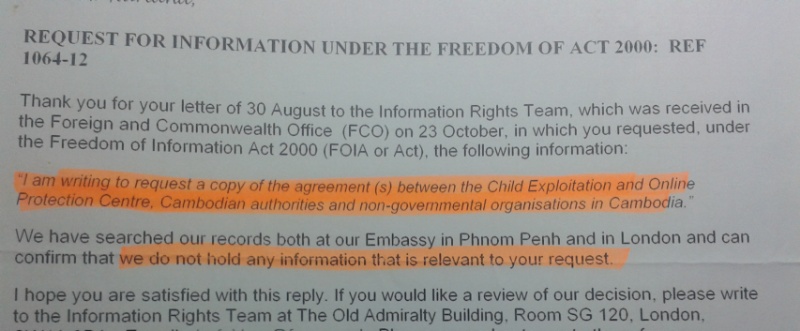
In October 2010, Jim Gamble, the former CEO of the British Child Exploitation and Online Protection unit (CEOP), came to Prey Sar prison in Cambodia.

This would be acceptable of course, if CEOP had evidence of a crime or some kind of official capacity in the prison.

The fact is that the FCO, a recognised CEOP partner, has no record of any agreements between CEOP and Cambodian authorities.


Prime Suspects (Arrested Developments) Wpid-wp-1415022200508

The FCO confirm there is no record of an agreement between CEOP and Cambodia

Other than the Red Cross and a few medical NGO’s, no visitors are permitted inside Prey Sar.

Undercover persecution

Jim Gamble actually came to Prey Sar for another purpose.

He entered Prey Sar, under the guise of a NGO filming prison conditions.

As a senior British police officer;
– he did not identify himself
– he did not brief detainees on their rights
– he did not explain the purpose of his unauthorised visit to Prey Sar prison.

Prime Suspects (Arrested Developments) Wpid-jimgamble
Jim Gamble, under cover, abusing prisoner rights

He abused his position, in order to persecute British, pre-trial detainees and as a result, also upset local detainees.

Torture
The unlawful actions of Jim Gamble could be described as degraging treatment, under the UN Convention Against Torture (CAT).

However, the British embassy will not support the victims of this action, despite the strong FCO position on acts of torture, inhuman and degraging treatment or punishment.

Perverting the course of justice

While in Cambodia and undercover Prey Sar prison, Jim Gamble produced a tabloid TV show with the American network CNN.
For this production, Jim Gamble also visited the NGO AFESIP, otherwise known as the Somly Mam foundation.


This NGO has hit regular headlines during the past years, regarding false statements and donor extortion.

https://childsexconspiracy.wordpress.com/2014/11/14/ceop-conspiracy/

[source unverified]


Is there a dark side to Jim Gamble, this champion of child protection?  There's certainly a lot more to this individual than meets the eye - enough to raise a few eyebrows.
-----------

More 'arrested developments' on this thread: https://jillhavern.forumotion.net/t15655-prime-suspects-arrested-developments

Tuesday, June 25, 2019

WAS JIM GAMBLE A CORRUPT POLICE OFFICER IN NORTHERN IRELAND? – AND DID HE AUTHORISE OR COVER UP MURDERS?


Tony Bennett originally wrote this article on 7 July 2015. It was revised and updated by MMRG on 14 May 2019.


WAS JIM GAMBLE A CORRUPT POLICE OFFICER IN NORTHERN IRELAND? – AND DID HE AUTHORISE OR COVER UP MURDERS?

A LOOK AT THE FINDINGS OF OPERATION BALLAST

First of all, a short biography

From Wikipedia:

“Earlier in his career he was Head of the Northern Ireland Anti-Terrorist Intelligence Unit in Belfast, then Deputy Director General (with the rank of Deputy Chief Constable) of the National Crime Squad, which, in April 2006, merged into the Serious Organised Crime Agency. He was also the Head of the Belfast Region of the Royal Ulster Constabulary’s Special Branch”.

Let there be no doubt whatsoever, then, that Jim Gamble, a long time ago - two to three decades ago, in fact - had, relatively early in his career, risen to one of the most senior roles in the country in the murky and sometimes sinister worlds of intelligence-gathering and Special Branch Operations. 

Those running the governments of the day and their intelligence and security operations must have had a very high degree of trust in him.

Here is an extract from an interview Jim Gamble gave to the Belfast Telegraph about his career:

“My father was in the RAF so I grew up with a service background. The natural progression was into the Army for me. I joined the military police. I was stationed in west Berlin…

"I joined the Royal Ulster Constabulary, then moved on to Special Branch.  When I came back to Northern Ireland it was initially with the bomb squad in a military police role and then I joined the Royal Ulster Constabulary, later moving on to Special Branch. I went through the ranks to be head of Special Branch in Belfast. As peace was breaking out, I passed the Strategic Command Course and ended up as the Assistant Chief Constable in the National Crime Squad.

“I then became Deputy Director-General of the National Crime Squad. I was asked to build a new organisation called the Child Exploitation and Online Protection Centre (CEOP). I resisted it at the beginning, I didn't think it was exactly what I wanted to do, and in the end it was one of the highlights of my career. What I will say is that I have been proud of many of the things I have done in my career and that pride is as strong as anywhere as regard that work we did in RUC Special Branch….every organisation will have bad apples, people who are motivated to do the wrong thing…”

++++++++++

Jim Gamble and Operation Ore

As we know, Jim Gamble was handed the job of leading one of the most controversial police operations ever to be run in this country: Operation Ore, an investigation into people in the UK accessing child sexual abuse images online.

Operation Ore began in 2002. 

Once again, what Wikipedia has to say on the subject:

“After 2003 Operation Ore came under closer scrutiny, with police forces in the UK being criticised for their handling of the operation. The most common criticism was that they failed to determine whether or not the owners of credit cards in Landslide's database actually accessed any sites containing child porn, unlike in the US where it was determined in advance whether or not credit card subscribers had purchased child porn. Investigative journalist Duncan Campbell exposed these flaws in a series of articles in 2005 and 2007.

“Many of the charges at the Landslide affiliated sites were made using stolen credit card information, and the police arrested the real owners of the credit cards, not the viewers. Thousands of credit card charges were made where there was no access to a site, or access only to a dummy site. When the police checked, seven years after Operation Ore commenced, they found 54,348 occurrences of stolen credit card information in the Landslide database. The British police failed to provide this information to the defendants, and in some cases implied that they had checked and found no evidence of credit card fraud when no such check had been done. Because of the nature of the charges, children were removed from homes immediately. In the two years it took the police to determine that thousands had been falsely accused, over 100 children had been removed from their homes and denied any unsupervised time with their fathers. The arrests also led to an estimated 33 suicides by 2007.

“One man was charged when the sole ‘suspicious’ image in his possession was of young-looking - but adult - actress Melissa Ashley. Also arrested were Massive Attack’s Robert Del Maja (later cleared) and The Who’s guitarist, who was cautioned by the police after acknowledging a credit card access to the Landslide website. Duncan Campbell later stated in PC Pro magazine that their credit card charges and IP addresses were traced through the Landslide site, and both were found to have accessed sites which had nothing to do with child pornography. The actor and writer Chris Langham was among those convicted.

“Independent investigators later obtained both the database records and video of the Landslide raid. When this information was presented in a UK court, Michael Mead of the United States Postal Service contradicted his US testimony under oath regarding several details relating to the investigation. As a result of the errors exposed in the cases, some people arrested in Operation Ore filed a group action lawsuit in 2006 against the detectives behind Operation Ore, alleging false arrest”.

I will add in here what Jim Gamble said to the Belfast Telegraph about how he came to lead - or rather, ‘review’ – Operation Ore, and become the Head of CEOP: 

"Almost by a quirk of fate one day I was asked to carry out a review of an operation called Operation Ore. Once I completed that review I recommended that because of the complexity of the technology involved, the weight of data coming in, that there needed to be an approach that was child-centred. Within a few days I was appointed as the lead for co-ordination of Operation Ore which for some was seen as contentious. I saw it as a huge success in that identified and located over 100 children and, over the years it unfolded, held more than 2,500 people to account. Having done that I was offered to take on the role setting up what was to become CEOP”.

And so it was that in April 2006, just one year before Madeleine McCann was reported missing, CEOP was formed. Once again, Jim Gamble was entrusted by the powers-that-be with running the entire CEOP operation.

++++++++++

Was Jim Gamble one of the police officers heavily criticised in the Operation Ballast report by Baroness O’Loan?

On 22 January 2007, Nuala O’Loan (now Baroness O’Loan), Police Ombudsman for Northern Ireland, reported on ‘Operation Ballast’, her investigation into alleged complicity by the police and security services in a series of murders between 1991 and 1997. Link here:

http://www.google.com/url?sa=t&rct=j&q=&esrc=s&source=web&cd=1&ved=0CB4QFjAA&url=http%3A%2F%2Fcain.ulst.ac.uk%2Fissues%2Fpolice%2Fombudsman%2Fponi220107mccord.pdf&ei=dpiZVYCJG4qqswHhmK-ACg&usg=AFQjCNGEglVfIcTVWbQ3ezsrAOcry23lLg&bvm=bv.96952980,d.bGg

As far as I know Jim Gamble was right at the heart of security and intelligence operations in Northern Ireland at this time. I believe that McCann Team investigator Dave Edgar was also employed in Northern Ireland at this time.

Topics covered by Baroness O’Loan’s enquiry were: 

1) two attempted murders in 1991.
2) the murder of Sharon McKenna on 17 January 1993.
3) the attempted bombing of the Sinn Fein office in Monaghan on 3 March 1997.
4) the blocking by Special Branch of searches during a pre-planned CID operation intended to disrupt the activities of the UVF.
5) the murder of John Harbinson on 18 May 1997.
6) the murder of Raymond McCord Junior on 9 November 1997.

I now quote from specific sections of Baroness O’Loan’s report. The whole report is an absolutely damning indictment of the activities of the Royal Ulster Constabulary but especially of the intelligence services and Special Branch, the areas for which Jim Gamble had prime responsibility. I could highlight in red the whole of these extracts from Baroness O’Loan’s report, but have just highlighted in red those areas that seem to relate particularly to Gamble’s role:

6. We examined Informant 1’s alleged involvement in drug-dealing between 1994 and 2003.

8. Other issues emerged during the course of the investigation…

32.4.  In the absence of any justifiable reason why officers behaved as they did, the Police Ombudsman has identified from police documentation, records and interviews, collusion in the following areas: 

• The failure to arrest informants for crimes to which those informants had allegedly confessed, or to treat such informants as suspects for crime;
By creating interview notes which were deliberately misleading; by failing to record and maintain original interview notes and by failing to record notes of meetings with informants;
• The failure to deal properly with information received from informants, so that informants were able to avoid investigation and detection for crime;
By arresting informants suspected of murder then subjecting them to lengthy sham interviews by their own handlers at which they were not challenged and then releasing them on the authorisation of the handler;
• By not recording in investigation papers the fact that an informant was suspected of a crime despite the fact that he had been arrested and interviewed for that crime;
• By failing to take steps to hinder an attempted bombing by the establishment of an operation either to disrupt or arrest the alleged perpetrators whose names were known to Special Branch;
• By giving instructions to junior officers that records should not be completed, and that there should be no record of the incident concerned;
• By ensuring the absence of any official record linking a Special Branch informant to the possession of explosives which may, and were thought, according to private police records, to have been used in a particular crime;
• By withholding information from CID that the UVF had sanctioned an attack;
• By concealing from CID intelligence that named persons, including an informant or informants, had been involved in particular crimes;
• By withholding information about the location to which a group of murder suspects had allegedly fled after a murder;
• By the concealment on a number of occasions of intelligence indicating that up to three informants had been engaged together in murders and a particular crime or crimes;
• By routinely destroying all Tasking and Co-ordinating Group original documentary records so as to conceal an informant’s involvement in crime;
• By destroying or losing forensic exhibits such as metal bars and tape lifts;
• By not requiring appropriate forensic analysis to be carried out on items submitted to the Forensic Science Service Laboratory;
• By blocking the searches of a police informant’s home and of another location, including an alleged UVF arms dump;
• By not questioning informants about their activities and continuing to employ informants without risk assessing their continued use as informants;
• By finding munitions at an informant’s home and releasing him without charge;
• By not informing local police of an anticipated attack, and not taking any action to prevent the attack;
• By not using the available evidence and intelligence to detect a crime and to link the investigation of crimes in which an informant was a suspect;
• By some Special Branch officers deliberately disregarding a very significant amount of intelligence about informant involvement in drug dealing in Larne, and North Belfast and in punishment attacks linked to drug dealing from 1994 onwards;
• By continuing to employ as informants people suspected of involvement in the most serious crime without assessing the attendant risks or their suitability as informants;
• By not acting on witness and other evidence received in particular crimes when the suspect was an informant;
• By not considering or attempting to conduct identification processes when there was particular evidence from witnesses about a criminal’s appearance;
• By providing at least four misleading and inaccurate confidential documents for possible consideration by the court in relation to four separate incidents and the cases resulting from them, where those documents had the effect of protecting an informant;
• By not informing the Director of Public Prosecutions that an informant was a suspect in a crime in respect of which an investigation file was submitted to the Director;
• By their failure to maintain the record of intelligence which was the basis for applications for extensions of time in detention to the Secretary of State;
• By withholding intelligence from police colleagues including the names of alleged suspects which could have been used to attempt to prevent and to detect crime;
• By the practice of Special Branch not using and following the practice of authorisation of participating informants;
• By completing false and misleading authorisations and reviews of informants for the purposes of the Regulation of Investigatory Powers Act;
• By cancelling the wanted status of murder suspects “because of lack of resources” and doing nothing further about these suspects;
• This investigation has examined the activities of police officers responsible for informants over a period of twelve years. On only one occasion have PSNI provided any document indicative of consideration of the termination of the relationship which Special Branch had with any of these informants, despite the extent of the alleged involvement of these informants in the most serious of crimes.

32.5. Special Branch systems for information management, dissemination and retention were seriously defective. In effect handlers, and on occasion controllers, determined what information went into such systems as did exist. Those systems which did exist were not effective.

33.6 There is evidence that information was withheld by handlers. Instructions were given that matters should not be recorded. The general absence of records has prevented senior officers, who clearly have significant responsibility for the failings, from being held to account. It is abundantly clear that this was not an oversight, but was a deliberate strategy and had the effect of avoiding proper accountability. The former ACC Crime Operations has described this situation as one of “plausible deniability”.

33.8 Police officers at all levels working in Special Branch very often determined the future dissemination, if any, of intelligence held within Special Branch, to officers outside Special Branch. Had the necessary systems of accountability been in place the situation which is described in this Report should not have arisen. However the reality was that a Constable or a Sergeant could, and did, refuse to divulge information even to senior officers, and the mechanisms by which the decisions of individual Special Branch officers could be challenged were not used effectively by senior officers. The Special Branch liaison officer for any particular investigation, who was responsible for the verbal passing of information, was very often the handler of an informant who was a prime suspect for the particular crime. The Police Ombudsman also identified abuses of the existing controls for dissemination which often resulted in the failure to disseminate information at an appropriate time.

There was no documented record of the reasons for the decision making in this area.

8.3. In the course of the investigation the Police Ombudsman sought the cooperation of a number of retired RUC/PSNI senior officers. Officers who were being treated as witnesses were asked to provide an explanation of Special Branch and CID internal practices during this period. Investigators offered to meet retired officers at venues with which they would be comfortable and at times which would suit them. They were advised of the areas of questioning and provided with significant disclosure of information, at their request. The majority of them failed even to reply. This was despite the fact that witness details would be anonomised in any public statement. Amongst those who refused were two retired Assistant Chief Constable’s, seven Detective Chief Superintendent’s and two Detective Superintendent’s.

Some retired officers did assist the investigation, and were helpful...

8.5. Others, including some serving officers, gave evasive, contradictory, and on occasion farcical answers to questions. On occasion those answers indicated either a significant failure to understand the law, or contempt for the law. On other occasions the investigation demonstrated conclusively that what an officer had told the Police Ombudsman’s investigators was completely untrue.

8.6 The evidence indicates that there was a major failure to ensure to ensure the proper management of Informant 1 and other informants…

++++++++++

So was Jim Gamble instrumental in ordering or authorising people to be murdered?

In the light of Baroness O’Loan’s report, the question must be asked.

We must also ask if Gamble was one of the police, intelligence and security service officers so severely condemned in this report. 

And as we consider those questions, we need to ask why Jim Gamble was given the task of heading up Operation Ore in 2002 and then entrusted with heading up the brand new government creation of CEOP in 2006. 

Gamble is on record, I believe, as denying that he is ‘named’ in Baroness O’Loan’s damning document. And he is quite right about that. He is not ‘named and shamed’. But was that a cunning evasion? Saying that he 'was mot named' in the report is NOT the same thing as saying he was not in fact one of the anonymous officers mentioned in the report. 


[UPDATE by MMRG: Look at a comparable example from the Madeleine McCann case. We know that on 13 May 2007 Jane Tanner identified Robert Murat, whom she had seen walking past an unmarked police car as part of a PJ identity parade, as the alleged abductor she claimed to have seen walking away from the McCanns' apartment, carrying a child. Later she changed her mind and said the person she saw looked like a man in an artist's sketch with straggly hair and a moustache (even though she had never seen the man's face!). 


Both she and the McCanns' PR spokesman Clarence Mitchell later said, in answer to questions, that they had never 'named' Robert Murat as the person she said she's seen. That was technically true. But it is also 100% true that she had identified him. - MMRG, 14 May 2019]      

But, surely, as the man at the heart of the corrupt, murderous, intelligence, security and Special Branch operations in Northern Ireland, Gamble is also condemned by Baroness O’Loan’s report?

My thesis is that, just like Clarence Mitchell, Jim Gamble is a man who is trusted by those at the very heart of our political establishment to do whatever is necessary.

Is that why both men - Gamble and Mitchell - were handed such key roles in influencing public perception about the reported disappearance of Madeleine McCann?


FURTHER READING ON CMOMM: 'JOINED AT THE HIP: Starring the McCanns and Jim Gamble':
https://jillhavern.forumotion.net/t9342-joined-at-the-hip-starring-the-mccanns-and-jim-gamble

---------------
For discussion, please visit this thread: https://jillhavern.forumotion.net/t11462-was-jim-gamble-a-corrupt-police-officer-in-northern-ireland-and-did-he-authorise-or-cover-up-murders

Monday, June 24, 2019

References to paedophilia in relation to the disappearance of Madeleine McCann

Paedophilia and paedophiles are words from which we naturally recoil. It is by no means a new phenomenon. There are many other words we use to refer to paedophiles: kiddie-fiddlers, nonces, child sexual abusers, child sex offenders and so on. Some of the crimes committed by paedophiles are scarcely believable in their brutality; other offences by them are mercifully less serious. One thing seems certain, such crimes are on the increase and are often severe in their long-lasting effects on those abused. There is widespread agreement that the internet is a major cause of any increase in this vile crime.

It is an unpleasant fact that the subject of paedophilia has frequently been associated in some way with the disappearance of Madeleine McCann, very regrettable though that is. Here, for the record, we give a brief summary of some of these references:


1. Dr Gerry McCann said on the day Madeleine was reported missing that Madeleine had been taken by a paedophile

Leaving aside for a moment the lack of direct evidence that Madeleine was abducted at all, there clearly is also no direct evidence whatsoever that, if Madeleine was abducted, that it was a paedophile who took her. Yet the McCanns themselves, on the very evening that Madeleine was reported missing, claimed she had been snatched by one or more paedophiles. That was a remarkable thing for them to say right from the first minute they reported Madeleine as missing. She might for example have wandered out of her room and out of the flat.

2. The McCanns and their team repeatedly said that Madeleine had been taken by a paedophile or a gang of paedophiles

In the months that followed her reported disappearance, the McCann Team made numerous references, counted in dozens, to the probability that Madeleine had been abducted by paedophiles.

3. One of the McCanns’ close friends, a General Practitioner, said that on a previous holiday together, one of Dr Gerald McCann’s best friends, Dr David Payne, had made sexualised remarks and gestures about Madeleine

On 16 May 2007, just 13 days after Madeleine disappeared, Dr Katarina Gaspar made this statement:

“One night, when all the adults, that is, from those couples I have mentioned above, were all sitting around on a patio outside the house where we were all staying. We had been eating and drinking ‘Berbers’. I was sitting between Gerry and Dave and I think both were talking about Madeleine. I can't remember the conversation in its entirety, but they seemed to be discussing a particular scenario. I remember Dave saying to Gerry something about ‘she’, meaning Madeleine, ‘would do
this’.

“While he mentioned the word ‘this’, Dave was doing the action of sucking one of his fingers, pushing it in and out of his mouth, while with his other hand he was doing a circle around his nipple, with a circular movement around his clothes. This was done in a provocative way. There seemed to be an explicit insinuation about what he was saying and doing. I remember being shocked by that. I always felt it was something very weird and that it was not something anyone should say or do. I looked at Gerry, and also at Dave, to gauge their reactions.

“I looked around as if saying: “Did someone else hear that, or was it just me?”. The conversations stopped for a moment, then we all began conversing again. Moreover, I remember Dave doing the same thing on another occasion. In saying this, I want to mention once again that it was during a conversation in which he was talking about an imaginary scenario, although I’m not sure.

“He again stuck one of his fingers in and out of his mouth and with the other hand he once again drew a circle around his nipple in a provocative and sexual way. I think he was referring to the way she, that is, his daughter Lily, would behave or what she would do. I think he did this later during this same holiday, but I'm not sure.

“The only time since then that I have been in the company of Dave and Fiona was several weeks after the holidays, when Savio and I met Gerry, Kate, Dave and Fiona in a restaurant in Leicester. I’m sure that he said what he said and made the gestures I have related, but [the second time] it could have happened in the restaurant in Leicester, although I do think it was in Majorca that I heard Dave say and do this for the second time. After the second occasion [when he made these gestures] I took it more seriously.

“I remember thinking whether he would look at my daughter and other little girls in a different way than I or others do. I imagined that he had perhaps visited internet sites related to little children. In a word, I thought that he could be interested in child pornography on the web. During our holiday in Majorca, each parent would bath the children in turn. I was keen to stay near the bathroom if Dave was bathing the children.

“I remember I said to Savio to be careful and to be close by if Dave was helping to bathe the children and my daughter in particular…”

4. Dr Katarina Gaspar’s husband, also a General Practitioner, Dr Arul Savio Gaspar, confirmed this event:

“During the period we stayed at the villa I remember a gesture made by David Payne. I do not remember the context of the conversation between David and Gerry, but I do remember seeing David use his left index finger to rub his nipple, using circular movements, whilst he put his right index finger into his mouth, touching his tongue. This happened during a meal, at the end of the day, in the villa. I do not remember the time or the date, but we would usually dine between 7.30pm and 9.00pm every day. I think this happened in the middle of the holiday.

“I remember that when I saw this gesture, I immediately thought it to be in very bad taste, independently of the context of the conversation they were having. We were sitting around a white plastic table in the villa. I don’t know if anyone else saw the gesture, apart from my wife Katherine”.

5. One of the suspects in the case, Robert Murat, was accused by two witnesses of having paedophile tendencies

A couple of days after Robert Murat was taken in for questioning by the Portuguese Police and formally declared a suspect, Dr Gerald McCann was asked: “Did you already know Robert Murat?” Dr McCann brushed the question aside impatiently and said: “I am not going to comment on that”. That led many to consider that the two men did previously know each other. It is a very reasonable inference to draw from his evasive comment.

Two witnesses claimed that Robert Murat had paedophile tendencies. One of them, who knew Murat well, made a detailed statement with some very graphic comments about Murat’s sexual preferences. The links for these statements are given on our website in a lengthy feature article about Robert Murat. The Portuguese Police discovered encrypted material on Murat’s computer after they seized it. Encryption is often used by those who view, download or exchange child pornography. Murat said he had ‘no idea’ why there was encrypted material on his computer.

6. Murat’s friend Sergei Malinka was also said to have child
pornography on his computer

A witness told Portuguese Police that Sergei Malinka, a friend of Murat who had worked on Murat’s website, also had an interest in child pornography and had child pornography on his computer. But the police found he had wiped all the data on his hard drive before the police examined it.

7. Jim Gamble, the Chief Executive of the Child Exploitation and Online Protection Centre (CEOP), used the Madeleine McCann disappearance to highlight the danger of paedophiles

Despite the high degree of uncertainty about what really happened to Madeleine, highlighted by their own spokesman, Clarence Mitchell, saying in March 2010 that her disappearance was ‘a complete mystery’, Jim Gamble, head of CEOP, relentlessly associated Madeleine with CEOP.  This was despite the obvious fact that the McCanns on their own admission had left three young children, all aged under four, in a vulnerable situation - for six nights in a row - and clearly failed to protect them. Many questioned why an organisation with the words ‘Child Protection’ in its title should feature the McCanns so heavily, given their failure of child protection.

Gamble, from 2007 onwards, heavily featured Madeleine on the CEOP website and in various CEOP publications. Around the time of the second anniversary of Madeleine’s disappearance (17 months previous to the date of this article , he appeared together with the McCanns in a so-called one-minute ‘viral video’, strongly emphasising that Madeleine was still alive and needed to be found.

Later he also appeared on morning news shows side by side with the McCanns.

Still more significantly, he invited Dr Gerald McCann in January 2010 to be the keynote speaker at a conference on the abduction of children by paedophiles. Why Dr McCann was considered by Gamble to be qualified to contribute to that conference, never mind being the ‘keynote speaker’, given the raft of uncertainties about the circumstances in which Madeleine disappeared, has never been explained either by the McCanns or by Jim Gamble.

Furthermore, it was reported - and confirmed by a Home Office Freedom of Information Act request - that in October 2009, the McCanns had a private interview with the McCanns. Following that, several press reports (not denied) indicated that the Home Secretary asked Jim Gamble to recommend a new British police force to carry out a review and possibly a re-investigation into Madeleine’s disappearance.

Some reports suggested that he had recommended West Yorkshire Police to carry out such a review. But the Home Office was unwilling to confirm or deny this. It was baffling why the Home Secretary, knowing Jim Gamble’s extreme closeness to the McCanns, should choose him to recommend who should carry out any review into Madeleine’s disappearance.

8. In the days before this article was written, Jim Gamble told the Home Secretary, Theresa May, that he was resigning from his post as CEOP Chief Executive, a resignation she swiftly accepted. The McCanns put out statements strongly supporting him, thanking him for his work on their behalf, and querying the Coalition government’s decision to incorporate CEOP within the Serious Organised Crime Agency (SOCA). They described his departure in graphic terms as ‘a huge loss to child protection’. These comments pointed inexorably, once again, to the conclusion that there was a very close ‘tie’ between the McCanns and Jim Gamble.  

The McCann Team in conjunction with Jim Gamble of CEOP published a video about Madeleine and circulated it round the internet which many believed showed her inappropriately posed in heavy make-up

In 2010, Jim Gamble once again co-operated with the McCanns to make a another video about Madeleine. The video in question featured three images of Madeleine. One very striking one shows her in an unusual pose, shot by the photographer from well below her face, wearing make-up, including much blue eyeshadow, lipstick and jewellery, and looking unhappy.

The McCanns publicly claimed that ‘the photo shows her when she was three after a raid on the dressing box’. However, it is very unlikely that Madeleine could have put the necklace on herself, nor applied eyeshadow in the manner shown in the photograph, nor applied the pink bow to her hair.

The evidence from the photograph suggests that an adult made her up and of course an adult was on hand to take that particular image of her. The McCanns did not say who took the photograph. Even if Madeleine had ‘raided the dressing box’, as claimed, it is one thing to take a photo of something like that for your family photo album, but altogether another matter to release it for millions to see.  

The McCanns explicitly approved the very public release of this video and the images on it. As one newspaper reported: “Parents of Madeleine McCann, who went missing three years ago, have released a new video and photo of their missing daughter to mark the third anniversary of the girl's disappearance”. The photo the McCanns specifically chose to highlight in the video was the one with Madeleine wearing heavy make-up, apparently applied by an adult and not by herself.

There was strong adverse reaction by many members of the public to this image being used in connection with a missing child. Not least was the opinion of Mr Mark Williams-Thomas, a former police detective and now leading criminologist and child protection expert, who has often in the past spoken with strong sympathy and understanding for the McCanns. His unambiguous reaction to this particular photograph, promoted on his ‘Twitter’ blog, was that it was ‘so inappropriate’ and ‘so damaging’. We agree with him.

The McCanns have from the day Madeleine was reported missing claimed explicitly and on many occasions that Madeleine must have been abducted by a paedophile, or paedophiles, often described by them as ‘predatory’, ‘evil’, or ‘monsters’. Yet the photo of Madeleine featured by her parents shows a child looking much older than her actual three years, due to the make-up and jewellery, as all the news media quickly picked up the following day.

The McCanns said a number of times that they were advised by the police ‘not to show any emotion’ in front of the cameras. One newspaper reported, around the time the McCanns appeared on the Oprah Winfrey Show:  “The couple also admitted they had been advised not to show any emotion while in front of the media, because any potential abductor ‘may get a kick out of it’.” It was all the more surprising, therefore, that the McCanns should use this short video to project and promote an image of Madeleine which might well appeal to certain paedophiles, some of whom are unfortunately attracted to young children.  

One person commented on ‘Twitter’ about the direct promotion of this video by CEOP Chief Executive Jim Gamble, writing: “If CEOP endorse this type of public relations for a supposed missing child, then their role in child protection has to be questioned!”  

9.  The McCann Team have highlighted the possible involvement of a named paedophile, Raymond Hewlett, in the disappearance of Madeleine

First they suggested that Hewlett was involved in Madeleine’s disappearance; latterly they have claimed that he gave an account of his knowledge of Madeleine’s disappearance in a letter he dictated to hospital staff in the weeks before he died. The claims made about this letter are highly improbable and we suggest that they are a complete fabrication. They have however been deliberately promoted by the McCann Team for 18 months.

10.  The connection between Ray Wyre, paedophile ‘expert’ and the McCanns

We’ve highlighted the connection between the late Ray Wyre and the McCanns in another article on our website, titled ‘Ray Wyre and the McCanns: What was the connection between the McCanns and the late paedophilia ‘expert’, Ray Wyre?

There are at least four questions we would ask about this connection:
  1. Why was Wyre so keen, in two articles published four and seven days after Madeleine was reported missing, to insist so adamantly that she had been abducted?
  2. Why, in addition, did he emphasise the possibility that she had been snatched by a paedophile?
  3. Why did the McCanns agree to meet the Wyres at the their Buckinghamshire home?
  4. Was that meeting really much more about producing a helpful Sunday newspaper article than, as was claimed, about starting a new organisation for missing children?
11. (NEW - UPDATED 15 June 2016) The McCanns’ friend, Sir Clement Freud, exposed as a serial paedophile

Following the reported disappearance of Madeleine McCann, the McCanns had dinner with the late Sir Clement Freud and his wife, Lady Freud. They had a villa in Praia da Luz, Portugal, where the McCanns had been holidaying. They became friends with each other. There had been strong rumours for years that Clement Freud was a paedophile. These have now been confirmed in an article for the Daily Telegraph on 14 June 2016, in which it was stated that Lady Freud apologised for her husband;s conduct and that Operation Grange would now investigate links between Sir Clement Freud and the McCanns.  Sir Clement died in 2009. 

Article filed by Tony Bennett, Secretary, The Madeleine Foundation, 10 October 2010 and updated by a Moderator on 15 June 2016


Monday, May 3, 2010

Letter from Madeleine Foundation to Jim Gamble 3 May 2010

Mr Jim Gamble Monday 3 May 2010

Chief Executive

Child Exploitation and Online Protection Centre
33 Vauxhall Bridge Road
LONDON
SW1V 2WG


Dear Mr Gamble

re: (1) Freedom of Information Act 2000 Questions

(2) CEOP’s close relationship with the McCanns - New video produced by Jon Corner and released by the McCanns, using images of Madeleine McCann with make-up and jewellery

We write to express our concern about the images of Madeleine used by the McCanns in relation to Madeleine on the recent video made by Jon Corner, which they released yesterday to much fanfare.

We do so for a number of reasons, including the very close nexus between yourself, CEOP and the McCanns (to which I shall refer below), and also of course because of your role as Chief Executive of CEOP, an organisation apparently dedicated to eliminating or minimising all forms of the exploitation of children.

The Madeleine Foundation is a membership organisation founded in 2008, partly to help learn the lessons from Madeleine’s disappearance, not least to campaign against the practice of leaving very young children on their own, thus exposing them to all manner of serious risks, not least that of being abducted. In a context where the McCanns’ spokesman, Clarence Mitchell, said as recently as 19 February in a Channel 4 interview that Madeleine’s disappearance remains ‘a complete mystery’, we also continue to work with others to try to establish what really happened to her and we campaign on a number of child welfare issues.

The video in question features three images of Madeleine. One very striking one shows her in an unusual pose, shot from well below her face, wearing make-up, including much blue eyeshadow, lipstick and jewellery, and looking unhappy.

The McCanns have claimed that ‘the photo shows her when she was three after a raid on the dressing box’. However, it is very unlikely that Madeleine could have put the necklace on herself, nor applied eyeshadow in the manner shown in the photograph, nor applied the pink bow to her hair. The evidence from the photograph suggests that an adult made her up and of course an adult was on hand to take that particular image of her. Even if Madeleine had ‘raided the dressing box’, it is one thing to take a photo of something like that for your family photo album, but altogether another thing to release it for millions to see.

The McCanns explicitly approved the very public release of this video. As one newspaper reported: “Parents of Madeleine McCann, who went missing three years ago, have released a new video and photo of their missing daughter to mark the third anniversary of the girl's disappearance”. The photo the McCanns specifically chose to feature was the one with Madeleine made up, apparently by an adult and not by herself.

There has been strong adverse reaction by many members of the public to this image being used in connection with a missing child. Not least was that of Mr Mark Williams-Thomas, a former police detective and now leading criminologist and child protection expert, who has often in the past spoken with strong sympathy and understanding for the McCanns. His unambiguous reaction to this particular photograph yesterday, and promoted on his ‘Twitter’ blog, was that it was ‘so inappropriate’ and ‘so damaging’. With respect, we agree with him.

The McCanns have from the day Madeleine was reported missing claimed explicitly and on many occasions that Madeleine must have been abducted by a paedophile, or paedophiles, often described by them as ‘predatory’, ‘evil’, or ‘ monsters’. Yet the photo of Madeleine featured by her parents shows a child looking much older than her actual three years, due to the make-up and jewellery, as all the news media yesterday quickly picked up.

You may recall statements made by the McCanns claiming that they were advised by the police ‘not to show any emotion’ in front of the cameras. As one newspaper reported around the time the McCanns appeared on the Oprah Winfrey Show: “The couple also admitted they had been advised not to show any emotion while in front of the media, because any potential abductor ‘may get a kick out of it’.”

It is therefore a matter of concern to us that the McCanns should project and promote an image of Madeleine which might well appeal to certain paedophiles, some of whom are unfortunately attracted to young children.

The general topic of the early sexualisation of young girls has recently been addressed by the Home Secretary, to whom you report and who appointed you. As a Guardian editorial earlier this year noted:

“It is a year since Jacqui Smith invited the TV psychologist Dr Linda Papadopolous to head a ‘fact-finding’ review. Her report describes a world where young girls who can barely walk are first cajoled into wearing high heels and T-shirts with Playboy motifs, before progressing into a grim future dominated by an internet-based youth culture that pressurises them into dress and behaviour which defines them overwhelmingly as sexual objects”.

The Home Office report stated: “The evidence gathered in the review suggests a clear link between consumption of sexualised images, a tendency to view women as objects and the acceptance of aggressive attitudes and behaviour as the norm”.

I enclose a copy of a letter sent yesterday to the chief public relations manager for the McCanns, Clarence Mitchell, expressing our concerns. In the light of the exceptional degree of publcity given by CEOP to the disappearance of Madeleine McCann and your own high degree of personal involvement, we would request you to give appropriate advice to the McCanns as to whether it is right to use these particular images, and especially the ‘make-up photo’, to draw attention to a missing child. We consider it sets a most unfortunate precedent if the one girl whose image has most frequently been used by CEOP to promote concerns about missing and exploited children should now be portrayed by an image which clearly shows her lookijg like a much older child (as the press realised straightaway) and wearing make-up applied by an adult.

May we also draw your attention to one specific comment made on ‘Twitter’ yesterday: “If CEOP endorse this type of public relations for a supposed missing child, then their role in child protection has to be questioned!” This is your opportunity to say unequivocally on behalf of CEOP and on behalf of missing children everywhere that CEOP does not approve of the use of such inappropriate images.

Your degree of commitment, on behalf of CEOP, to the McCanns, has been immense, despite the doubts prompted by their being made ‘arguidos’ and being pulled in for questioning and the contents of the interim police report of senior police inspector Tavares de Aleida.

You have heavily featured Madeleine McCann on your website and in other publications about your work. You appeared together with the McCanns 12 months ago in a one-minute ‘viral video’, strongly emphasising that Madeleine was still alive and needed to be found. You also appeared on morning news shows side by side with the McCanns.

You also invited Dr Gerald McCann in January to be the keynote speaker at a conference of the abduction of children by paedophiles, a matter that concerned many of us, as there is not a shred of evidence that Madeleine was abducted by a paedophile. On top of all that, Home Secretary Alan Johnson recently asked you to recommend a new British police force to carry out a review and possibly a re-investigation into Madeleine’s disappearance and, according to press reports, you have already delivered your recommendation to him. In view of this intense activity on behalf of the McCanns, then, you are without doubt in a powerful position to advise them as to their choice of images being used to remind people about Madeleine. We trust you will provide suitable advice to them.

The role and activities of CEOP: Freedom of Information Act 2000 requests

We understand that CEOP has a role as a police force and has powers to investigate alleged crimes relating to missing, abducted and exploited children. We have also seen recent publicity in which, as we understand it, you have advised children, young people and their parents to report possible crimes against children such as ‘internet grooming’ directly to yourself and not to their local police force. We have also seen recent publicity in which you have publicly threatened ‘Facebook’ with various sanctions if they do not adopt your suggestion of a compulsory ‘panic button’ linked to your website.

We presume that as a public authority you must be covered by the Freedom of Information Act and therefore under the FOI Act we ask the questions below. If you are not covered by the Freedom of Information Act, we trust you would answer our questions anyway, as they are clearly in the public interest:

1. What legal powers are available to CEOP and its staff?

2. Under what powers can CEOP insist or encourage children, young people and their parents to report alleged crimes to CEOP rather than to their local police force?

3. What action does CEOP take if they have reasonable grounds for believing that an offence against children has been or is being committed; do they investigate and if necessary charge the offender themselves, or do they refer cases to the local police service, or does it depend on the circumstances? If so, what are the criteria for deciding whether a case is investigated by the police or by yourselves?

4. What campaigning work, if any, has been carried out by CEOP to stem the rising tide of the sexualisation of young children, upon which so many commentators have remarked recently?

5. How many staff does CEOP employ?

6. What was the annual cost of CEOP for the last year for which figures are available?

7. Please refer us to any campaigning work CEOP has done on the risks to children posed by known sex offenders released into the community or to any statements made by CEOP on this issue.

8. Has CEOP expressed a view on current proposals, supported at the last annual conference of the Liberal Democrats, to allow 16- and 17-year-olds to view pornography and visit sex shops; if so, please direct us to where any such statements may be found.

Finally, to the extent that CEOP is effectively addressing the main issues concerning missing, abducted and exploited children, we fully support your organisation’s work and I would be pleased if you could kindly send us a paper copy of your latest annual report.

We look forward to hearing from you.

Yours sincerely

Tony Bennett,

Secretary

Popular Posts

My Blog List

My Blog List